

Summary
- Integrated microwave assemblies can consolidate multiple RF functions into a common package, which helps defense platforms address space, interconnect, and system-level constraints.
- The advantages of integrated microwave assemblies include lower RF loss, more direct thermal paths, and greater repeatability between assemblies.
- An IMA can make sense for a defense project when space, interconnects, RF loss, thermal management, or production requirements are becoming difficult to manage with a discrete architecture.
More coverage. More channels. Same size and weight constraints.
If you’ve designed RF systems for defense applications, you know the challenge of fitting more RF capability within defined size and weight constraints.
There is only so much room on an airframe or vehicle. Separate components also mean more connections, transmission lines, connectors, and transitions, which increase the size and complexity of the RF system.
An Integrated Microwave Assembly (IMA) can address some of these constraints by combining multiple RF functions into a common assembly. Depending on the architecture, this can help you reduce the number of your external interconnects and transitions while making more efficient use of your available space.
But integration also changes how you access and work with those functions during tuning, testing, and troubleshooting.
So, at what point does integrating multiple microwave functions into a single assembly provide a meaningful advantage for your defense project? Before considering a shift from discrete components, what electrical, mechanical, and system-level factors should guide the decision?
5 Advantages of Integrated Microwave Assemblies in SWaP-Constrained Platforms
The diagrams below compare a discrete downconverter with an integrated microwave assembly.
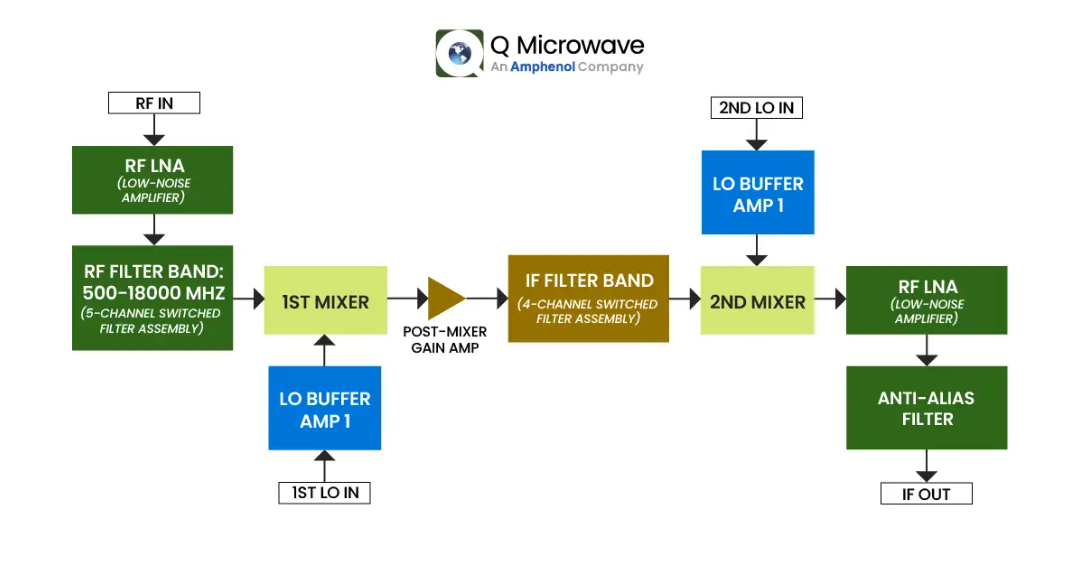
Diagram 1. Discrete Downconverter RF Block Diagram Architecture
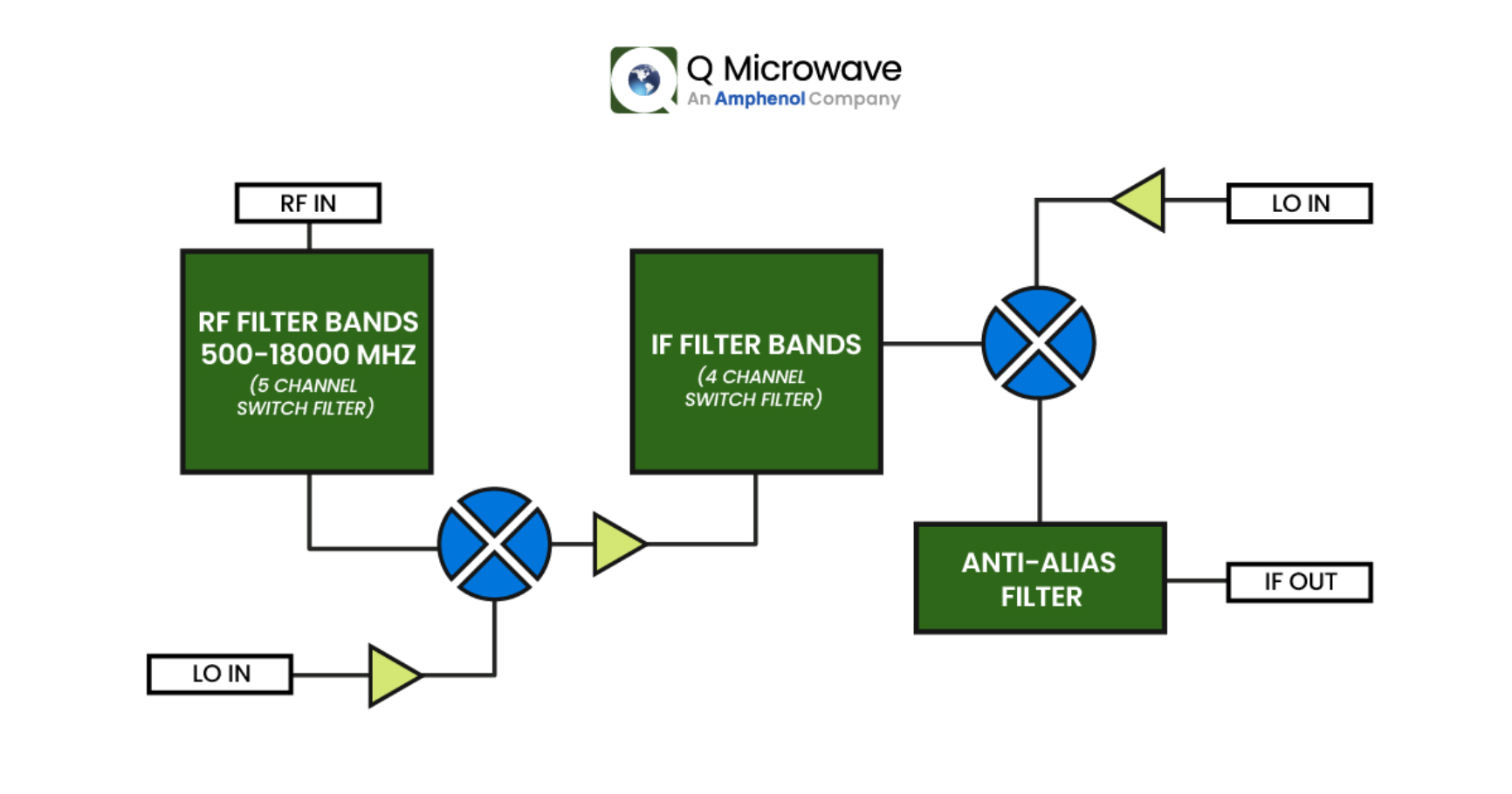
Caption: Diagram 2. Q Microwave Dual-stage Conversion Wideband RF Downconverter
How you package these functions can affect your RF performance, thermal management, mechanical design, testing, and system integration.
As you can see in the diagrams above, a discrete architecture gives you more separation between individual RF stages, but it also introduces additional interfaces, interconnects, and mechanical hardware. Meanwhile, an integrated microwave assembly combines multiple functions within a single package, which can reduce those interfaces and give you more control over how your RF, mechanical, and thermal requirements come together.
But what does integrating those functions change from an RF system design perspective?
-
Reduced Interconnects Between RF Components
More RF functions can mean more component-to-component interfaces. Each interface represents another connection or transition in the RF signal path.
In the downconverter shown above, for example, the RF filter, LNA, mixer, IF filter, and IF amplifier are packaged separately, with connectors, transmission lines, and transitions linking each stage. Each interface requires additional hardware and installation space while also introducing insertion loss, impedance discontinuities, and additional variables into the RF path.
An IMA brings multiple stages into a common structure, which can reduce the number of external connections and the hardware required to support them. For a defense platform with limited space and weight, fewer connections and less supporting hardware can make the overall RF implementation more compact without removing any required functions.
However, fewer external connections do not automatically mean better RF performance. An IMA still needs careful control of its internal RF interfaces to maintain signal integrity and prevent unwanted coupling or discontinuities. -
Smaller Physical Footprint
As mentioned in the earlier section, a smaller footprint gives you more flexibility when fitting RF hardware into limited platform space, especially when multiple RF chains or subsystems need to occupy the same area. Your RF chain competes for space with antennas, processors, power electronics, cooling hardware, and other mission equipment. The space taken up by the RF implementation can directly constrain the layout of the rest of your system.
An IMA gives you more control over how the RF functions, interfaces, and supporting hardware occupy the available volume. Depending on the architecture, this can reduce your installed footprint compared with separately packaged stages. -
Lower RF Loss Through Shorter Signal Paths
In a discrete architecture, your RF signal passes through multiple connectors, transitions, and transmission lines between stages. Each interface contributes insertion loss, so those losses can accumulate across your signal path. An integrated microwave assembly can shorten some of these paths by placing multiple RF functions within a common structure. Fewer external interfaces and shorter paths between stages give you fewer points where insertion loss can accumulate.
Still, path length is only one contributor to the total insertion loss of your RF chain. You can quantify the net loss and compare the actual performance of the two architectures by characterizing the complete RF path through measured or modeled S-parameters. -
Lower Power Requirements and More Direct Thermal Paths
When you integrate multiple RF functions into a common assembly, you also change how you manage power and heat. Instead of treating each stage as a separate component with its own package and thermal interface, you can design the RF chain around a shared mechanical and thermal structure.
Integration does not inherently make your RF components more efficient. However, a well-designed IMA can reduce some of the power associated with supporting hardware while giving you more direct thermal paths from heat-generating devices into the assembly and, ultimately, the system-level thermal solution.
Having shorter thermal paths can also help you reduce thermal resistance between your active devices and the heat sink or chassis. You can also place heat-generating stages strategically within the assembly and design the mechanical structure around their thermal requirements. -
Improved Repeatability
When you build an RF chain from separately packaged components, the final assembly depends on how those components and interfaces come together. Connector interfaces, transmission-line transitions, mounting conditions, and component tolerances can all influence the measured response from one unit to the next.
An integrated microwave assembly gives you the opportunity to control these variables as part of your assembly design. You can define the RF interfaces, mechanical relationships, and critical dimensions within the same structure rather than treating each connection as a separate integration point. This level of control can help you maintain more consistent electrical performance across your production units.
You can also characterize the integrated assembly as a complete RF structure rather than qualifying each component independently and accounting for its interfaces during final integration. This should give you a defined RF response to build against as you move from prototype to production.
Could an IMA Address Your Defense Platform’s SWaP Constraints?
An IMA is most applicable when your RF architecture has reached a level of maturity where your interfaces, component selection, and performance requirements are already well defined. Before replacing a discrete implementation, consider how the architecture is expected to evolve and what constraints are driving the integration.
- Architecture maturity. If your component selection, specifications, or RF interfaces are still changing, you can retain more flexibility during development with a discrete architecture. Once your signal chain stabilizes, you can integrate it into a custom assembly with greater confidence.
Pro Tip: Not every RF function needs to be integrated at the same stage of your development process. If a filter, amplifier, mixer, or frequency-conversion stage is still being optimized, keeping it discrete can make iteration easier. Integrate the functions that have established requirements while preserving access to stages that are likely to change.
- RF and mechanical development. A custom IMA brings the RF, mechanical, and thermal design together. You define the internal interfaces and transitions, design the thermal paths, set mechanical tolerances, and characterize the completed RF structure as part of the same assembly.
- Qualification. Your custom IMA must meet the same environmental, RF, thermal, and mechanical requirements as the platform it will operate in. You need to account for those requirements during the IMA design and verify the completed assembly through the qualification testing specified for the application.
- Production. A custom IMA requires upfront engineering for RF, mechanical, thermal, and qualification requirements. You need a stable architecture and defined production volume before committing to a custom assembly that will carry those requirements across the platform lifecycle.
However, SWaP constraints alone do not determine whether an IMA is the better architecture for your defense platform.
"A discrete architecture may still be preferred during prototyping or research, when individual components need to be tested or modified. It can also make upgrades easier, since you can replace or update a single component without redesigning the entire assembly, as you might need to do with an IMA.”
- Rafid Ali, Applications Engineer, Q Microwave
To figure out whether integration can address your specific constraints, consider what’s limiting your current RF chain. Look at factors such as the number of external interfaces, available space, insertion loss, thermal resistance, and the mechanical requirements of connecting multiple RF stages. If an IMA addresses those limitations without sacrificing what you need from a discrete architecture, it may be the better fit for your use case.
If you are evaluating an IMA for your RF architecture, Q Microwave can help you determine how you can approach the integration and what needs to be designed into the assembly from the start. Our engineers bring experience in RF filter design, microwave subsystems, mechanical packaging, RF simulation, and production testing, allowing us to address the electrical and physical requirements of the assembly together. We can develop custom solutions such as switched filter banks, frequency converter assemblies, transmit/receive modules, and other integrated RF and microwave assemblies based on your system requirements.
Q Microwave also supports the design beyond the initial RF concept, with in-house testing, S-parameter characterization, environmental screening, configuration control, and manufacturing capabilities for both prototype and production requirements. That means you can evaluate the complete assembly as a defined RF structure rather than treating its filters, interfaces, packaging, and interconnects as separate pieces.
If you are working through an RF integration challenge, contact Q Microwave to discuss your requirements and determine whether a custom IMA is the right fit for your architecture.
Integrated Microwave Assembly FAQs
Q: What RF functions can you integrate into a single assembly?
A: You can integrate multiple RF functions into a single assembly, including filters, amplifiers, mixers, attenuators, switches, couplers, and frequency-conversion stages. How many functions you combine depends on your frequency range, power levels, isolation requirements, thermal load, and mechanical constraints. We evaluate the signal chain as a whole to identify which functions benefit from shorter internal paths and controlled RF interfaces, rather than integrating components simply to reduce the number of packages.
Q: Does integrating RF functions always improve RF performance?
A: No. Integration can reduce external interconnects and signal-path length, which can lower cumulative insertion loss and reduce opportunities for mismatch. But integration alone does not determine your RF performance. You still need to account for impedance control, grounding, isolation, coupling, thermal effects, and RF transitions within the assembly. Compare the measured or modeled S-parameters of your complete signal path to determine how the integrated assembly affects your RF chain’s insertion loss, isolation, and overall response.
Q: When should you choose an integrated microwave assembly over discrete RF components?
A: An IMA makes the most sense when your RF architecture is mature and your system-level constraints make a discrete implementation difficult to package, connect, cool, or manufacture. Evaluate your available volume, number of RF interfaces, signal-path loss, thermal paths, production requirements, and how likely your design is to change before choosing an architecture. If your signal chain is still changing frequently or you need direct access to individual components during development, a discrete architecture may give you more flexibility to modify, replace, or evaluate individual RF stages without redesigning the entire assembly.
_