

Introduction High pass filters (HPFs) play a critical role in RF systems by allowing high-frequency...
.jpg)
Summary
- Radar and satellite systems are just two examples of microwave frequency applications, which allow for high-resolution sensing, rapid data transfer, and compact, efficient hardware.
- Making the right engineering choices, such as selecting the frequency band, designing components to match wavelength, integrating modules, and handling environmental and spectrum constraints, is essential to achieving your desired performance.
- Working with experienced vendors and using pre-tested integrated microwave modules helps you achieve mission-ready performance without excessive prototyping or risking signal degradation.
Microwave frequencies set the limits of what your defense and communication systems can do, but they also open doors that lower frequencies can’t reach. Short wavelengths enable precise tracking of fast-moving objects while high-frequency satellite links support large data transmissions over long distances.
However, this precision comes with challenges. As you move your microwave frequency application into X, Ku, and Ka bands, tolerances tighten significantly. Wavelengths shrink to the scale of manufacturing variations, so standard interconnects and environmental stresses, which were previously negligible at lower frequencies, can suddenly compromise performance and impact your link budget.
To succeed, you must understand these physical limitations and actively engineer around them. In this blog, you’ll explore how microwave frequencies influence system behavior, alongside the engineering decisions and vendor strategies needed to translate designs into mission-ready hardware.
Microwave Frequency Applications in Defense and Aerospace
Microwave frequencies, roughly 1 GHz to 300 GHz, are the foundation of modern radar and satellite systems. They enable capabilities that lower-frequency systems cannot deliver:
High-Resolution Sensing
Longer wavelengths, such as HF or VHF, require extremely large antennas to achieve comparable resolution, which is impractical for modern platforms. Meanwhile, shorter wavelengths enable radar systems to detect small or fast-moving targets with high precision, providing the spatial resolution necessary for accurate tracking and discrimination.
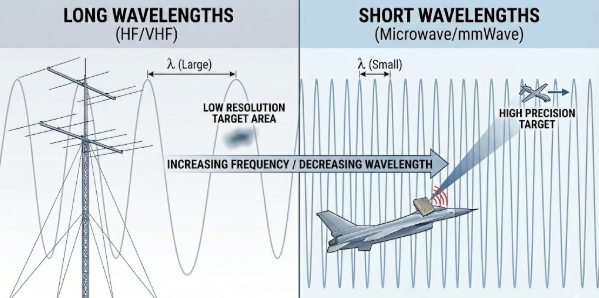
A diagram comparing low-frequency and high-frequency bands
High Data Rates
As the frequency goes up, the bandwidth, or the amount of information a signal can carry, increases as well. If you tried to use lower-frequency signals to carry the same data volume, you’d either need enormous antennas or have to send the signals for a really long time to get the same amount of data through. Microwave frequencies avoid these constraints and support high-resolution signal processing and precise radar and satellite operation.
Compact Integrated Hardware
Because microwaves have short wavelengths, components such as antennas, filters, and amplifiers can be physically compact. Smaller parts allow them to be consolidated into a single integrated module rather than using separate bulky pieces. This not only saves space but also improves performance, since signals travel shorter distances between components.
How to Address Microwave Frequency Application Trade-Offs
Designing systems for microwave frequencies requires careful attention to the trade-offs that come with short-wavelength operation. Microwaves enable high resolution, wide bandwidth, and compact components, but those same characteristics introduce constraints to your hardware. Addressing these trade-offs early in the design process helps ensure the system meets its requirements, remains practical to build, and performs as expected under demanding operating conditions.
Choose the Appropriate Microwave Frequency Band Early
Selecting a frequency band (X, Ku, or Ka) sets limits on what your system can achieve, from resolution and data rate to antenna size and propagation loss. Because these capabilities are tightly coupled to frequency, you can guide trade-off decisions between performance and implementation by defining your resolution and data-rate requirements before evaluating specific microwave frequency bands:
- Define system requirements. Start by specifying the resolution and data-rate needs of your microwave frequency application.
- Evaluate trade-offs. Shorter wavelengths, such as Ka-band, provide higher resolution and wider bandwidth but are more susceptible to rain fade and atmospheric absorption.
- Perform link budget analysis. Account for expected path loss, atmospheric effects, and potential interference to ensure the chosen microwave frequency band meets performance objectives.
These decisions directly affect antenna specifications, power levels, and filter design, and should be finalized well before hardware selection.
Translate Wavelength into Physical Design
When you design arrays, antennas, or filter modules, treat wavelength as a fundamental constraint. Start by spacing elements in phased arrays using λ/2 or λ/4 rules to prevent grating lobes and pattern distortion. Next, simulate coupling between closely spaced elements so you can control interactions before they degrade performance. Then, let wavelength guide your PCB layout, including trace spacing, ground planes, and thermal vias, to maintain Q-factor, insertion loss, and isolation.
Thinking about wavelength as a physical limit from the start can help you keep your system’s performance intact as components become more compact.
Integrate Components to Preserve Performance
For rapid prototyping or systems with loose volume constraints, discrete commercial off-the-shelf (COTS) components offer flexibility and low upfront effort. However, for mission-critical designs where SWaP and noise figure are important, you should transition to Integrated Microwave Assemblies (IMAs).
When your sensitivity requirements are stringent, switching to an IMA removes the insertion loss and VSWR mismatches associated with connecting discrete 50-ohm blocks. This approach requires more upfront engineering than using off-the-shelf components, but it delivers a substantially lower noise figure and a compact footprint suitable for constrained airframes, where discrete chains are impractical.
Account for Environmental and Spectrum Constraints
To ensure that your system will perform reliably once launched, you must look beyond the ideal conditions of the lab and design for the hostile realities of the field, whether that involves atmospheric physics or a congested spectrum.
For satellite communications, you need to build sufficient link budget margin to account for rain fade, atmospheric absorption, and Doppler shifts that can push signals out of your passband. For radar systems, the challenge often lies in simulating interference from high-power adjacent bands, such as 5G networks, to prevent receiver saturation.
Ultimately, you need to design filters with steeper rejection skirts and robust shielding to block unwanted signals while strictly adhering to your mechanical and footprint constraints.
Leverage Vendor Expertise for Mission-Ready Designs
Datasheet specifications alone don’t guarantee field-ready performance. Bringing in partners allows you to check component performance and achieve compliance with design specifications.
- Use proven, high-reliability assemblies. Choose integrated microwave modules (filters, switches, and LNAs) that Q Microwave pre-tests to MIL-/space-grade standards to validate system performance before full integration.
- Take advantage of tested packaging options. Surface-mount, hybrid, and microstrip assemblies endure vibration, thermal cycling, and harsh environmental conditions typical of satellite or electronic warfare applications.
- Leverage partner testing and validation. Q Microwave rigorously tests components in its facilities (MIL-STD-202/883), so you can confirm that insertion loss, isolation, and noise figure meet specifications before committing to system integration.
- Align design decisions with vendor capabilities. Coordinate early with a vendor such as Q Microwave to match filter topologies, LNA performance, and module integration to your system requirements to reduce surprises during integration and testing.
Achieve Precision with Custom Microwave Assemblies
Working at microwave frequencies demands that signal chains be designed with fully integrated modules, where active and passive components are impedance-matched to ensure selectivity and minimize unwanted emissions.
Q Microwave bridges the gap between schematic theory and operations through a vertically integrated process of design, packaging, and qualification:
- Q Microwave’s team works directly with your block diagram to model integrated topologies, using electromagnetic and thermal simulation to optimize SWaP-C (Size, Weight, Power, and Cost) before a single component is fabricated.
- We transition designs into ruggedized hardware using laser-welded housings and hermetic sealing techniques, ensuring that sensitive microelectronics are physically isolated from environmental stress while maintaining electrical transparency.
- Every assembly undergoes Environmental Stress Screening (ESS), including random vibration, thermal cycling, and leak testing per MIL-STD-883/202, to make sure that the unit will perform as predicted in the harshest mission profiles.
Are you ready to see this in practice? Contact Q Microwave and explore how custom integrated assemblies can optimize your system’s noise figure and SWaP profile.
Microwave Frequency FAQs
Q: Why does my link budget show a passing Noise Figure (NF) using discrete COTS components, but the actual hardware fails sensitivity tests at Ka-band?
A: This is often due to the unmodeled "connector penalty" and VSWR interactions between discrete stages. In a discrete chain, the cable and connector interfaces between the filter and LNA introduce insertion loss. According to the Friis transmission equation, any loss before the first gain stage adds dB-for-dB to your system's Noise Figure. Furthermore, if the filter’s output impedance isn't perfectly matched to the LNA’s input (which is common in 50-ohm COTS parts), you get standing waves that create passband ripple. Integrated Microwave Assemblies (IMAs) solve this by removing the connectors and allowing for direct conjugate matching between the filter and LNA, recovering the sensitivity lost to interface mismatch.
Q: We are under pressure to reduce SWaP. At what point does physically shrinking a cavity filter compromise its power handling capabilities?
A: You hit the limit when the Unloaded Q-factor (Qᵤ) drops below what is required for thermal dissipation. As you shrink a resonator's volume, the surface current density increases, which lowers Qᵤ and increases insertion loss. That increased loss converts RF energy into heat. If the physical surface area is too small to dissipate that heat, the filter will experience thermal drift (detuning) or, in high-power vacuum applications, suffer from Multipaction breakdown. If you need to go smaller than physics allows for an air cavity, you must switch topologies (e.g., to dielectric resonators) rather than simply scaling down the geometry.