

Summary The passband is the non-negotiable window for the mission-critical signal, but it's more...
Summary
- Short microwave wavelengths turn board layout, substrate materials, and mechanical tolerances into critical circuit elements, meaning even microscopic manufacturing variations directly impact signal integrity and phase coherence.
- Lab-tested components can’t always handle what your system demands. In such cases, you need tailored solutions to maintain performance in the field.
- Custom RF assemblies streamline the signal chain, reduce losses, and enhance noise performance when standard components fail to meet high-frequency demands.
Designing at microwave frequencies challenges you in ways that lower-frequency systems never do. Every signal is sensitive to its environment, which means minor signal integrity impairments can compromise how your systems will perform under temperature, mechanical stress, and electromagnetic extremes.
Microwave environments demand a level of precision that leaves almost no room for error. While standard catalog components and simulation tools provide a powerful foundation, demanding high-frequency applications often require performance characterization that exceeds general-purpose datasheets or idealized models. To avoid integration risks, you must look beyond these specifications and account for the rigorous manufacturing and environmental realities of your specific application.
This article analyzes the trade-offs in microwave design and offers strategies through answers to the following questions:
- Why do frequency and wavelength matter in microwave design?
- What do RF engineers need to consider when creating high-frequency systems?
- How do microwave frequencies enable radar and satellite technology?
- How do you choose RF components for your project?
Why Do Frequency and Wavelength Matter in Microwave Design?
Every constraint in RF design flows from a relationship:

Where f is frequency, λ is wavelength, and c is the speed of light.
As frequency increases, the wavelength becomes shorter. While this is basic physics, it requires you to rethink your approach when working in the microwave spectrum.
At lower frequencies, components are "electrically small,” which makes a resistor behave like a resistor while a trace behaves like a simple wire. However, as you move into C-band, X-band, and millimeter-wave spectrums, the wavelength shrinks to the same physical scale as your circuit elements. This means that you need to shift from working with lumped elements to working with distributed-element designs, introducing three physical realities that determine performance:
1. The Layout Becomes the Circuit
Microwave frequencies make traces, pads, and connectors behave differently. They start acting as transmission lines, antennas, and resonators, with each copper trace showing characteristic impedance, propagation velocity, and insertion loss that influence how signals travel through the system.
The physical geometry of these components defines their electrical behavior, which means that even small deviations in gaps or dimensions can disrupt impedance matching, generate reflections measured as VSWR, and degrade the overall performance of the signal chain.
2. The Substrate Dictates the Wavelength
The physical length of your structure is determined by the guided wavelength (λg) inside the material, rather than the free-space wavelength (λ0). This ties the final physical dimensions directly to the substrate’s dielectric constant (εr).
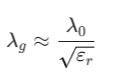
If your substrate’s εr varies due to temperature changes or manufacturing inconsistencies, which is common in standard materials such as FR-4, the guided wavelength shifts. This physically "detunes" your filters and alters the phase relationship between antenna elements. For high-reliability designs, achieving consistent dielectric behavior requires specialized RF substrates.
3. Mechanical Tolerances Become Electrical Specs
Millimeter-wave signals have very short wavelengths. That means very small physical differences, even as small as a fraction of a hair’s width, can change the resistance, capacitance, or inductance in your traces and components, which then affects how signals travel. For example, a resonator that is slightly too long will shift the passband lower, potentially cutting off the signal you are trying to receive.
In phased-array radars, even small differences in trace length can break the phase coherency required for accurate beamforming. At this scale, mechanical tolerances are no longer separate from electrical performance. Every dimension matters electrically, which means that you cannot treat the mechanical housing as independent from the schematic.
What Do RF Engineers Need to Consider When Creating High-Frequency Microwave Systems?
If physics sets the rules, the environment breaks them. In a simulation, a radar system is a series of perfect mathematical blocks. However, in reality, it is a volatile signal chain where every interface is a potential failure point.
Challenges in Signal Chain Integration
Even if each component performs perfectly on its own, the system’s performance at high frequencies depends on how the parts interact, not just on their individual specifications.
- Filter-to-LNA Interface. Impedance mismatches between a filter and a Low Noise Amplifier (LNA) create standing waves (VSWR) that introduce passband ripple. In radar systems, this ripple distorts the pulse shape and reduces range resolution.
- Connector Transition Effects. At microwave frequencies, connectors act as transmission line discontinuities. Poor return loss increases insertion loss and reduces system sensitivity.
- Thermal Drift in RF Components. Filters and local oscillators (LO) can drift in opposing directions with temperature changes and compromise phase coherence and Doppler detection.
Environmental and Operational Stressors
High-frequency radar systems operate in extreme environments and must comply with standards such as MIL-STD-810 or AS9100. To design a system that can withstand harsh operating conditions, you must anticipate:
- Temperature Variations. Thermal expansion changes resonant cavity dimensions and shifts the operating frequency.
- Mechanical Vibration and Shock. Structural stress damages solder joints or connectors, creating intermittent noise.
- Radiation Exposure. In space applications, ionizing radiation degrades material dielectric properties, which affects RF performance over time.
RF Chain Performance Parameters
Component selection in the RF chain is governed by critical specifications that directly affect overall system sensitivity:
| Parameter | Definition | Mission Impact |
|
Noise Figure (NF) |
Degradation in signal-to-noise ratio (SNR). | Higher NF reduces radar detection distance. |
| Group Delay Flatness | Rate of phase shift change through the device. | Poor flatness disperses signals and blurs target resolution. |
| Gain and Linearity | Amplification without distortion. | Nonlinear behavior produces intermodulation products and generates false targets. |
| Power Handling | Maximum power before saturation or failure. | Exceeding limits damages transmit/receive paths. |
| VSWR | Voltage Standing Wave Ratio (impedance matching). | Impedance mismatches cause power loss and reduce how far your signal can go. |
High Frequency RF Circuit Design Challenges and Strategies
To bridge the gap between a laboratory prototype and a field-deployable system, you need to carefully understand the details of your signal chain:
Cascade Effects
Even when each component meets its specs, connecting them in a chain can produce unexpected results. For example, a small impedance mismatch at a filter output can reflect part of the signal back and subtly shift the amplifier’s phase response. Tiny insertion losses can also accumulate stage by stage, and what looks like a clean gain curve in isolation can dip or ripple across the band. These are the effects you only see when the chain is assembled.
You can prevent these effects by performing chain-level co-design and simulating cascaded S-parameters early in the design process. Where possible, combine the filter and low-noise amplifier into a single tuned assembly to reduce mismatches and preserve signal integrity.
Laboratory vs. Field Performance
Components that perform well at room temperature don’t always behave the same under actual operating conditions. To prevent surprises, characterize all critical components across the full temperature range, choose temperature-compensated or ruggedized parts, and test them under the conditions your system will actually experience.
Insertion Loss
Small losses in connectors, traces, or passive components can accumulate and significantly reduce system SNR and radar range.
To maintain your system’s performance, track every source of loss and choose low-loss substrates, high-Q cavity filters, and precise interconnects. This way, you protect signal integrity and make sure your system reaches its full range potential.
How Do Microwave Frequencies Enable Radar and Satellite Technology?
Microwave bands from 1 to 300 GHz give you capabilities that lower frequencies cannot achieve. Their short wavelengths let you achieve high-resolution sensing, wide bandwidth, and smaller, more compact systems.
- High-Resolution Sensing. Short wavelengths allow detection of small radar cross-section (RCS) targets, including drones and missiles, which you cannot reliably track at VHF or L-band.
- High Data Throughput. Available bandwidth increases with frequency, supporting multi-gigabit links for real-time satellite imagery and high-rate telemetry.
- Reduced SWaP. As the wavelength decreases, the component size also decreases. You can integrate filters, low-noise amplifiers (LNAs), and switches into a single compact module suitable for constrained platforms, such as missile nose cones or CubeSat payloads.
Microwave Design Considerations and Trade-offs
1. Frequency Band Selection Resolution versus Atmospheric Loss
When choosing a frequency band, you need to balance the desire for high resolution against the impact of atmospheric loss. Higher-frequency bands, such as Ka and V, provide better resolution and wider bandwidth, but they are more susceptible to attenuation from rain and other atmospheric conditions. Lower-frequency bands, such as S or X, are often better for long-range ground radar because they suffer less from these losses. For satellite communications or high-throughput data links, Ka-band can deliver superior performance, but you must include adequate margins in the link budget to account for weather effects.
Define the worst-case link budget first and make sure the system can meet performance requirements even under the most challenging atmospheric conditions.
2. Wavelength-Dependent Layout Constraints
In phased-array antennas, the tiny antennas (called elements) have to be spaced very carefully, about half the size of the radio wave they’re sending or receiving. This spacing prevents the antenna from accidentally sending energy in the wrong directions, which we call grating lobes.
When you move to very high frequencies, such as above 40 GHz, the radio waves are so short that the spacing between elements becomes smaller than a millimeter. At this scale, how you place every element on the board really matters. You also have to carefully arrange thermal pathways (to remove heat) and grounding layers.
If you don’t plan it right, the elements can interact with each other in unexpected ways, creating “leaks” of energy (parasitic coupling) that distort the antenna’s pattern. That means the antenna won’t send or receive signals in the directions you expect, and the whole system performs worse.
3. Component Integration versus Discrete Modules
Using discrete components gives you flexibility and modularity, but every connector or transition adds insertion loss and reflections, which increase the system’s noise figure. Integrating filters, LNAs, and switches into a single Integrated Microwave Assembly (IMA) reduces these transitions, improves noise performance, and preserves signal integrity. For systems with strict size, weight, and power constraints, IMAs are usually the better choice. In fact, the improvement in insertion loss alone often justifies the additional upfront non-recurring engineering effort required to design the assembly.
Q Microwave specializes in designing and manufacturing these Integrated Microwave Assemblies (IMA) to meet your exact system requirements. We combine active and passive components such as filters, switches, and amplifiers into compact custom housings that fit tight spaces. Our engineering team works directly with you to take complex specifications and turn them into reliable hardware ready for the field.
How Can I Choose RF Components for My Project?
Microwave engineering is governed by strict physical and operational limits. As you move from X-band to V-band, your margin for error shrinks dramatically.
To succeed in microwave design, you must go beyond selecting lab-tested components and create a signal chain that works reliably under actual mission conditions.
Pre-Sourcing Design Readiness Checklist
Verify your design before you issue a Request for Quote or finalize the Bill of Materials. Follow these steps to make sure your system meets your high-frequency requirements.
- Audit the link budget. Account for worst-case insertion loss, noise figure, and temperature extremes. Do not rely only on nominal datasheet values.
- Define the integration boundaries. Calculate the cumulative losses and VSWR ripple caused by connectors and interconnects when using discrete filters, mixers, and amplifiers.
- Verify environmental requirements. Ensure components survive vacuum conditions, high vibration, or high-power operation as required. Perform tests to ensure components operate correctly in the required environments.
- Assess SWaP-C limitations. Identify whether standard components restrict the board layout. Consider custom housings or integrated assemblies to reclaim critical volume and maintain performance.
Get Custom Solutions for High-Frequency Challenges
If your system requires capabilities beyond off-the-shelf components, Q Microwave can help. We can shrink a filter bank to fit a new airframe or combine multiple RF components into a single custom microwave assembly.
Our process starts with a close collaboration with your engineering team. We review your system requirements, identify critical specifications, and evaluate trade-offs for size, weight, power, and performance. From there, we design, simulate, and prototype a solution based on your application and validate it under the environmental and operational conditions your system will face. Get in touch with Q Microwave to discuss how we can integrate your components into a high-performance custom solution.