

Summary Short microwave wavelengths turn board layout, substrate materials, and mechanical...

Summary
- Microwave frequency and wavelength directly determine RF signal propagation and how signals interact with distributed circuit elements.
- As wavelengths shrink, the substrate’s dielectric constant becomes a critical variable, capable of altering guided wavelength and detuning filters or antennas.
- High-frequency designs require abandoning standard manufacturing tolerances in favor of EM simulation and precision fabrication to manage the physical effects of short wavelengths.
There are simple equations so fundamental that they shape the form and function of everything that follows. In RF design, one such rule is the relationship between microwave frequency and wavelength.
Where:

λ is the wavelength, f is the frequency, and c is the speed of light in the medium (approximately 3×10⁸ m/s in free space). According to this formula, frequency and wavelength are inversely related: an increase in frequency results in a corresponding decrease in wavelength. Meanwhile, a decrease in frequency produces a longer wavelength.
While it appears to be straightforward, high frequencies can profoundly affect physical behavior. At lower frequencies, your components remain electrically small, which means you can still accurately describe them using lumped-element models. However, as frequency increases into the C-band, X-band, and millimeter-wave bands, the wavelength shrinks to the same physical scale as the circuit elements themselves.
Designing with high frequencies requires treating traces, pads, and connectors as more than simple wires. Instead, they begin to act like miniature antennas or resonators, storing and radiating energy along their length. So, even small changes in layout, length, or spacing can affect your project’s signal strength, introduce reflections, or shift the operating frequency of a circuit.
Let’s examine how this frequency-wavelength relationship impacts engineering decisions in radar, communications, and electronic warfare systems, and what you can do to make it work for your project.
Effects of Microwave Frequency and Wavelength Relationship in Physical Design
A wavelength sets the scale of a signal as it travels through a circuit. At low frequencies, the wavelength is much larger than the size of typical components, often measuring several meters. In these cases, you can treat resistors, capacitors, and inductors as ideal lumped elements without worrying about their exact size or placement, and your circuit will function as expected even if you don’t arrange the components precisely.
However, as you increase frequencies into the microwave and millimeter-wave ranges, the waves shrink to dimensions comparable to your circuit features. Your traces, component pads, and gaps between elements then behave as transmission lines, with distinct characteristic impedance, propagation velocity, and loss.
At this scale, your physical layout defines the circuit, and you move from lumped-element to distributed-element design.
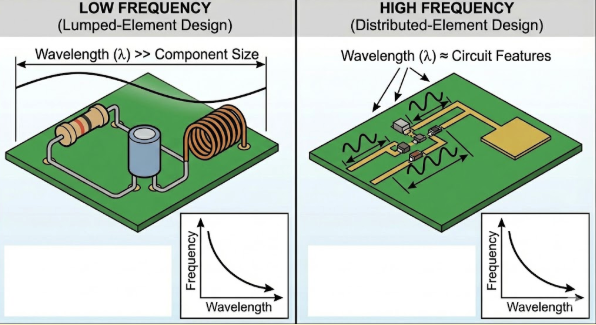
Low-frequency vs. high-frequency PCB layouts
But layout isn’t the only factor you need to focus on. Once you reach very high frequencies (GHz range and above), the type of PCB substrate you use becomes as important as the shape and spacing of traces.
The substrate’s dielectric constant (εr) determines the guided wavelength on a PCB, according to λg ≈ λ0 / √εr. Small variations in ε, due to manufacturing tolerances or temperature changes, directly affect the guided wavelength, which can:
- Detune filters so they fail to operate at their intended frequencies.
- Shift the antenna phase and alter signal timing between elements, which affects impedance matching.
- Degrade performance in radar, communications, or electronic warfare systems, reducing reliability.
Why Does This Matter?
At low frequencies, such as in an audio amplifier or a simple power supply, a wire behaves essentially as a simple conductor. Small differences in layout have minimal effect on circuit operation, so the design remains robust.
But at high frequencies, the wavelength of the signal becomes so tiny that it shrinks to the same size as the copper traces and component pins. Because the wavelength is similar to the size of the metal traces, they can radiate energy, store energy, and reflect signals, just like intentional antennas or filters. In other words, the layout itself starts acting like a circuit element.
These effects complicate performance, size, and fabrication, even in well-designed circuits.
Transmission Lines Replace Simple Conductors
A copper trace on a circuit board functions as a "transmission line" at high frequencies instead of a simple conductor. The precise geometries etched into the copper create the filters and couplers, meaning a minor layout deviation can lead to complete design failure.
Substrate Material Governs Performance
The substrate's material properties (its dielectric constant, ε) directly govern the signal's wavelength and, therefore, your circuit's performance. At high frequencies, normal PCB materials such as FR-4 are too inconsistent and lossy.
- Its dielectric constant (εr) can vary from board to board or even across the same board.
- It has higher signal loss at high frequencies, which reduces signal integrity.
To design circuits that behave predictably, you need specialized RF substrates with precise and stable electrical properties.
Microscopic Manufacturing Errors Matter
When the signal's wavelength measures just a few millimeters, a microscopic manufacturing flaw, such as a trace deviating by 0.05 mm or a substrate layer being out of tolerance, changes the electrical length of the circuit. This alters the resonance of filters and shifts the phase of signals in antennas or transmission lines, which can prevent the circuit from operating at its intended frequency and cause the system to fail.
Engineering Strategies for High-Performance Microwave Design
Rely on Electromagnetic (EM) Simulation
To achieve accurate high-frequency performance, move beyond traditional circuit schematic simulation (such as SPICE) and use full 3D electromagnetic (EM) field simulations. This allows you to model the electromagnetic behavior of the physical layout, including traces, vias, component pads, and interconnects.
EM simulation accurately models how electromagnetic waves propagate, reflect, and radiate in the actual 3D structure, enabling you to predict and validate performance before committing to fabrication.
Specify Controlled High-Frequency Substrates
Not all PCB materials work well for high-frequency microwave and millimeter-wave circuits. To maintain predictable signal propagation and circuit performance, you must select specialized RF substrates, which are materials engineered for a stable dielectric constant (εr) and low loss tangent (tan δ) over the required frequency and temperature ranges. These substrates ensure that traces, transmission lines, and circuit elements behave as intended, which can minimize shifts in filter frequencies, antenna phase errors, and other performance deviations.
Implement Robust Design and Tolerance Analysis
Of course, you strengthen your design process by accounting not only for nominal component values but also for manufacturing tolerances and process variations. This involves two important actions:
Tolerance Analysis
Use statistical tools to simulate how minor and unavoidable manufacturing variations (for example, ±0.05 mm in trace width or ±2% in εr) will impact performance. This analysis will help you predict production yield and identify which design parameters you must control most carefully.
Select Robust Topologies
Intentionally select circuit designs and physical geometries, such as wider transmission lines or specific filter types, that are inherently less sensitive to these small manufacturing variations to achieve consistent performance.
Leverage Specialized Manufacturing Partners
Implementing these strategies for every component demands significant time and expertise. Even as a highly capable engineer, you can’t always justify running full EM simulations, validating materials, and performing detailed tolerance analyses for every filter in a system.
You can also work with a microwave filter expert, such as Q Microwave, to streamline this effort. You can rely on a partner who has already solved these challenges at scale and can give you access to validated high-performance components to reduce manufacturing risk and maintain performance specifications even under demanding conditions.
Partner With Experts Who Understand High-Frequency Design
Understanding the inverse relationship between frequency and wavelength is a core concept that sets high-frequency microwave engineering apart from low-frequency electronics. As this article has shown, this relationship shapes circuit topology, material selection, layout strategy, and the manufacturing tolerances that determine whether a design succeeds or fails.
But mastering these concepts doesn’t mean you need to take on every high-frequency challenge alone. Q Microwave can help you solve these complexities. Our expertise lies in turning system-level requirements into high-performance and mission-ready hardware. We support your design efforts by:
- Performing detailed 3D EM simulation
- Managing rigorous material qualification
- Controlling precision manufacturing processes for filters and other RF components
Ready to reduce risk and streamline high-frequency development? Contact Q Microwave today to discuss your component requirements with our engineering team.
Microwave Frequency and Wavelength FAQs
Q: Is there a specific frequency where I need to switch from lumped to distributed design?
A: As the article explains, the transition happens based on the scale of your components relative to the wavelength. You need to switch to distributed design techniques (treating traces as transmission lines) whenever the signal's wavelength shrinks enough to become comparable to the physical dimensions of your traces and pads.
Q: What does it mean that the "layout defines the circuit" at high frequencies?
A: It means that you can no longer rely solely on the discrete components (inductors, capacitors) to define the circuit's behavior. Because the wavelength is so short, the copper traces themselves store and radiate energy, effectively acting as components. Consequently, the physical shape, width, and spacing of your layout become just as important as the schematic in determining the final performance.
Q: Why do shorter wavelengths make a design more sensitive to manufacturing errors?
A: This is a matter of proportion. At lower frequencies with long wavelengths, a microscopic manufacturing error, such as a variance in trace width, is physically insignificant. However, when the wavelength is only a few millimeters long, that same microscopic error represents a significant percentage of the total signal cycle. This disrupts the signal's phase or impedance, which is why high-frequency designs require such tight fabrication tolerances.


.jpg?height=200&name=Blog%20Images%20(2).jpg)