

Introduction High pass filters (HPFs) play a critical role in RF systems by allowing high-frequency...

Summary
- Lowpass filter signal processing requires engineers to balance signal integrity with the specific demands of the application.
- Q Microwave helps RF engineers develop lowpass filters around their specific requirements by balancing electrical performance, form factor, manufacturability, and testing throughout the design process.
- A well-designed lowpass filter is not simply one that meets its simulated specifications, but one that can be built, tested, and tuned to deliver the required performance in its intended application.
Every RF engineer understands how powerful a well-designed lowpass filter is for refining communication signals. However, it's still a puzzle how one can fully optimize its capabilities to get the cleanest and most reliable output, considering the variety of conditions and trade-offs present. Achieving that level of performance requires careful component selection and impedance matching, particularly in demanding radar, satellite communications, or avionics environments.
Q Microwave addresses these design challenges by tailoring each lowpass filter to the requirements of its intended application.
Q Microwave has been an industry leader for over 25 years, proudly utilizing advanced techniques and innovative strategies to optimize lowpass filter performance. We’re excited to give you a sneak peek of how our experts craft high-performance lowpass filters.
Challenges in Conventional Signal Processing
1. Signal Integrity Issues in High-Frequency Environments
Military and aerospace communication systems face significant challenges when operating at high frequencies. Rapid signal oscillations can lead to electromagnetic interference (EMI), disrupting mission-critical systems and degrading overall performance. These systems can also experience unwanted reflections, signal loss, and phase distortion, which can compromise radar and avionics accuracy.
Advanced lowpass filters and RF components require careful design and precision to address these issues and meet military and aerospace standards. Aerospace systems, in particular, need reliable filters that work in the vacuum of space and handle rapid atmospheric shifts to maintain stable communication and signal transmission over long distances.
2. Technical Limitations of Standard Lowpass Filters
Standard off-the-shelf lowpass filters can be a practical choice for applications with straightforward requirements, but they may fall short when a project calls for more specific performance characteristics.
Custom lowpass filters address signal integrity and high-frequency performance trade-offs to overcome the limitations of off-the-shelf filter designs for various applications:
- Military Applications. Lowpass filters eliminate unwanted harmonics and allow only the desired signal to pass through to improve target detection accuracy.
- Satellite Communication. High-performance filters suppress out-of-band emissions, reduce interference risks, and provide precise and dependable signals for secure transmission.
Modern avionics, which involve an intricate interplay of numerous RF components, also benefit from state-of-the-art lowpass filter technologies that deliver optimized in-band performance and minimize signal reflection.
Ultimately, there is no right or wrong choice between an off-the-shelf and custom lowpass filter. The better fit depends on how closely a standard component can meet the project’s electrical, physical, and manufacturing requirements. To make that assessment, it’s important to understand what a lowpass filter is designed to accomplish and what the limitations are.
Q Microwave’s Approach to Lowpass Filter Design and Manufacturing
Q Microwave uses innovative and proprietary methods to tackle the challenges of designing and manufacturing lowpass filters for military and aerospace projects. Our team will design, simulate, and deliver filter designs appropriate to your application requirements while balancing trade-offs between performance, size, and manufacturability.
Let’s examine how Q Microwave approaches lowpass filter design and manufacturing for various applications.
Customized Lowpass Filter Design
Q Microwave guarantees to work closely with our clients to balance lowpass filter performance, form factor, size, and cost-effectiveness.
Our process begins with understanding each project's requirements: Does the project require an exceptionally compact filter, or is the priority on maintaining the lowest possible insertion loss? For instance, lumped element filters allow for a smaller packaging size but may cause higher insertion loss in narrowband applications than ceramic resonators or combline filters.
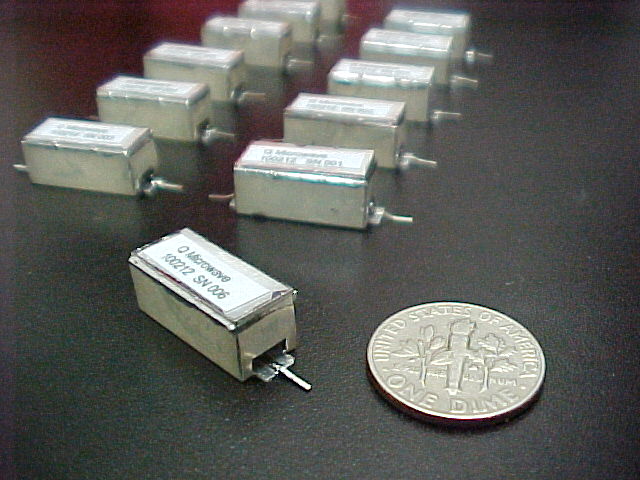
Q Microwave´s Miniature Lumped-element Filter
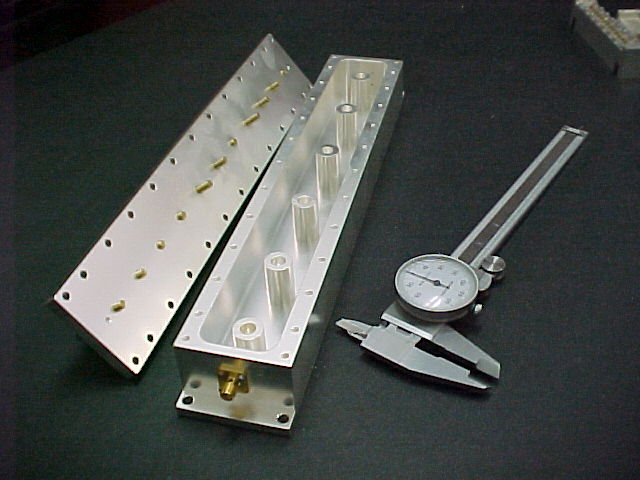
Q Microwave´s Standard Combline Filters
Simulation-Driven Filter Design
Q Microwave utilizes powerful simulation tools, such as AWR Microwave Office, to generate preliminary designs before moving on to prototyping. Our engineers use software tools to create detailed models of lowpass filters and optimize their parameters before fabrication.
Our team guarantees efficient and feasible lowpass filter designs, avoiding configurations that are theoretically promising but impractical to implement.
“There's a difference between what can be physically built and what can be simulated. While simulations can make anything seem feasible, real-world constraints often differ. It’s important to include a buffer between the final specification and the simulation to provide headroom, as the built product will never perfectly match the simulation.”
- David Higginson, MBA, PMP, Director of Business Development, Q Microwave
Our proprietary methods also push the envelope regarding the testing process. We have developed a unique way of replicating the ‘cover effect’ without an actual cover to make tuning and testing more efficient.
Comprehensive Testing Protocols for Quality Assurance
Q Microwave filters undergo demanding tests, such as vibration, shock, and temperature testing, in conditions they are likely to experience during real-world military and aerospace operations.
We also evaluate filter performance using a Vector Network Analyzer (VNA). A VNA provides scattering parameters (S-parameters) to determine gain, loss, impedance, and phase group delay. It also validates performance metrics against the simulation model to meet insertion loss, return loss, ripple, and rejection criteria.
Expert Input on Your Filter Design
On top of understanding their process, choosing the right filter manufacturer also requires knowing the questions to ask a microwave filter company before moving forward with a design. Q Microwave takes the time to answer those questions, discuss your application requirements, and explain the design considerations behind the recommended filter approach.
Achieve Superior Signal Performance with Custom Lowpass Filters
Lowpass filters maintain signal integrity and high performance in advanced communication systems. Custom lowpass filters take this further with state-of-the-art solutions to enhance accuracy, reduce interference, and improve overall reliability for demanding applications.
Are you ready to build the best lowpass filter for your project? Q Microwave is a leader in crafting innovative, high-quality, custom lowpass filters designed for these requirements. With AS 9100 and ISO 9001 certifications, Q Microwave guarantees industry-leading quality and precision.
Trust Q Microwave for precision, reliability, and excellence in every lowpass filter. Contact Q Microwave today!
___________________________________________________________________________________________________________________________________________________________
Lowpass Filter Signal Processing FAQs
Q. How do lumped-element and combline filter topologies compare in microwave signal processing?
A. Lumped-element filters use discrete components to achieve a compact form factor, while combline filters use resonant structures that can provide lower insertion loss and stronger performance at higher frequencies. The right topology depends on factors such as frequency range, bandwidth, size constraints, and required electrical performance.
Q. Why choose custom RF lowpass filter signal processing over off-the-shelf components?
A. Custom RF lowpass filters let you design around the specific requirements of your application instead of adapting an off-the-shelf component to fit them. Q Microwave can optimize the filter design for factors such as insertion loss, rejection, size, and manufacturability to achieve the required performance.
Q. When should I select a Lumped-Element (LC) architecture over a Combline or Microstrip lowpass filter topology?
A. A Lumped-Element architecture can be a good choice when a compact form factor is a priority and the operating frequency and bandwidth suit discrete components. Combline or Microstrip designs may be better suited when the application calls for different performance characteristics or higher-frequency operation.

-1.jpg?height=200&name=Untitled%20design%20(11)-1.jpg)